
Sunday, January 11, 2026
Discover what is a content calendar: A Practical Guide
Discover what is a content calendar and how it can transform your content strategy. Learn to plan, organize, and publish with confidence.
Think of a content calendar as the strategic blueprint that dictates when and where you publish your upcoming content. It’s not just a schedule. It's the command center that aligns your marketing, keeps your messaging consistent, and turns random acts of content into a cohesive, powerful strategy.
Your Strategic Content Blueprint
Imagine trying to build a house without an architect's blueprint. You might end up with walls in the wrong places, a roof that doesn’t fit, and a chaotic, stressful process. That's exactly what creating content without a plan feels like.
A content calendar is that essential blueprint. It provides structure, purpose, and direction for everything you create and share.
It’s so much more than a simple list of post dates. A well-built content calendar is a living document that gives you the power to:
Visualize Your Strategy: See your entire plan for the week, month, or even the quarter at a single glance.
Maintain Consistency: Ensure a steady stream of content, which is crucial for keeping your audience engaged and the algorithms happy.
Align Your Team: Keep writers, designers, and marketers on the same page by clarifying roles, deadlines, and responsibilities.
Prevent Last-Minute Scrambling: Eliminate that daily panic of, "What are we going to post today?" by planning ahead.
The Evolution from Spreadsheet to Command Center
The need for content calendars absolutely exploded as social media became a dominant force in our lives. Global usage is expected to surpass 5.4 billion users by 2026, with the average person juggling 6-7 different platforms every month. This fragmentation pushed marketers beyond simple spreadsheets and into the world of more dynamic, purpose-built tools. You can discover more insights on social media usage trends on planable.io.
To keep up, the simple content calendar had to evolve. A modern calendar does far more than just list dates; it's a central hub for the entire content operation.
Core Functions of a Modern Content Calendar |
|---|
Function |
Strategic Planning |
Workflow Management |
Cross-Channel Visibility |
Collaboration Hub |
Performance Tracking |
This shift from a passive tracking document to an active workspace is what separates a basic schedule from a true content command center.
A modern content calendar isn't just a static schedule; it's a dynamic workspace. It integrates planning, creation, collaboration, and even performance analysis into one unified workflow, turning chaos into a predictable and scalable process.
Today’s advanced platforms, like Beplan, have fully realized this evolution. They offer features like drag-and-drop scheduling, channel-specific post previews, and collaborative approval workflows. This allows creators not just to organize their ideas, but to optimize their entire content engine for maximum impact.
The Building Blocks of a Powerful Content Calendar
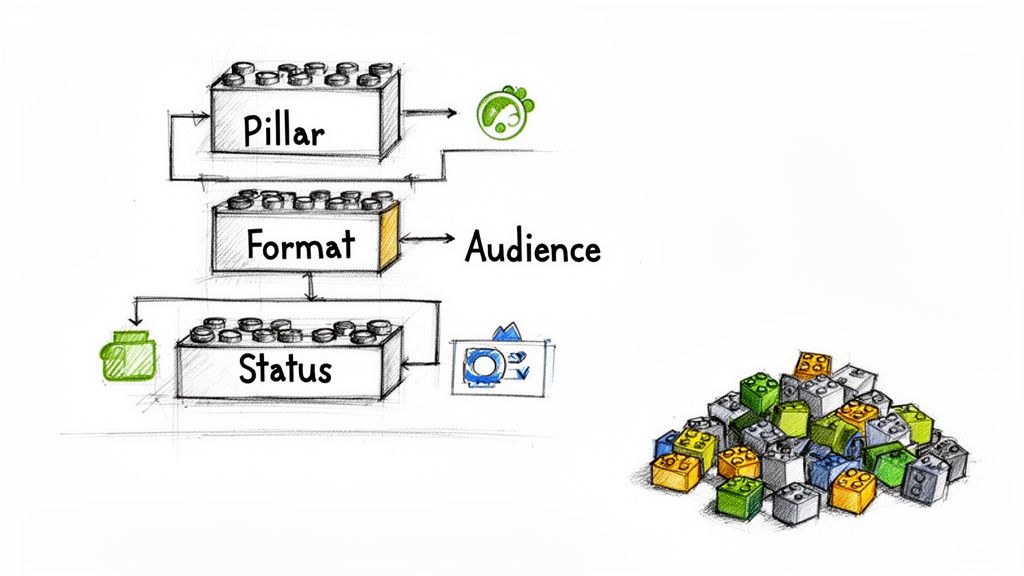
Think of a truly effective content calendar like a set of LEGOs. Each component is a different block, and when you snap them all together, you build something strong and cohesive. A simple schedule might tell you when to post, but a strategic calendar answers the what, who, and why behind every single piece of content.
This is what turns your calendar from a basic to-do list into a strategic command center. Let’s break down the essential blocks you need to include.
Core Content Pillars and Themes
Your content pillars are the foundational topics your brand owns. These are the 2-4 core subjects you talk about so consistently that your audience starts to associate them with you. For a fitness creator, these pillars might be "HIIT Workouts," "Nutrition Tips," and "Mindfulness."
By sticking to your pillars, you keep your content focused and relevant. Every post should tie back to one of these themes, reinforcing your expertise and brand identity. It’s what stops your feed from feeling like a random collection of disconnected ideas. Our guide on how to plan social media content dives deeper into developing these pillars.
Platform and Content Format
Here’s a hard truth: not all content works everywhere. A fast-paced Reel that crushes it on Instagram will fall flat as a detailed LinkedIn article. Your calendar needs to specify both the platform (e.g., Instagram, X, YouTube) and the content format (e.g., Carousel, Video, Blog Post).
This level of detail is a game-changer for a few reasons:
Tailored Messaging: It forces you to adapt your message to each platform's unique audience and algorithm.
Production Planning: It immediately clarifies what you need to create, whether it's video clips, high-res photos, or a written draft.
Content Mix Balance: You can see at a glance if you're leaning too heavily on one format, helping you diversify to keep things fresh.
A great content calendar doesn’t just schedule a generic idea; it schedules a specific format for a specific platform, ensuring every post is optimized for its environment from the very beginning.
Publication Status and Key Details
Finally, a truly functional calendar needs those operational details that keep the machine running smoothly. This includes things like publication status (e.g., Idea, In Progress, Ready for Review, Scheduled), who’s responsible for it, and any relevant campaign tags.
A clear status lets everyone on the team see a post's entire lifecycle at a glance, preventing bottlenecks and miscommunication. Adding details like campaign tags (e.g., #SummerSale2024) allows you to group related content together and track the performance of specific initiatives later on. These small details are what transform a calendar into a true command center for your entire operation.
How a Content Calendar Solves Creator Burnout
We’ve all been there: the constant, nagging pressure to post something—anything—followed by the last-minute scramble for ideas. That frantic, reactive cycle is a one-way ticket to burnout. A content calendar is your strategic defense against this chaos, turning a stressful grind into a sustainable, predictable workflow.
Instead of waking up and thinking, "Ugh, what am I supposed to post today?" you already know exactly what's on the docket. That simple shift frees up a massive amount of mental energy. The time you once spent panicking can now go into what actually matters: creating higher-quality, more thoughtful work.
Think of a content calendar as your tool for taking back control. By planning ahead, you make sure your content mix is balanced, your posting schedule is consistent (which the algorithms love), and everything you create lines up with your bigger goals.
From Last-Minute Panic to Proactive Planning
Without a plan, creating content often feels like you're just treading water. You might accidentally post three sales-y pieces in a row or completely miss a key holiday because you were too swamped to think ahead. A calendar gives you that bird's-eye view to catch these common slip-ups before they happen.
It lets you map out your content against important dates, product launches, or seasonal trends, making sure what you post is always relevant and timely. It’s the difference between chasing trends and setting them.
This organized approach is more critical than ever. The average person scrolls social media for about 2 hours and 21 minutes daily, yet engagement rates are tanking across major platforms. We’re talking drops of 16% on Instagram, 34% on TikTok, and 36% on Facebook. This means posting more intentionally is way more important than just posting more often. A calendar helps you align your posts with data-backed peak times, so you can see at a glance that your most important content is set up for maximum impact. You can dig deeper into social media trends on coolnerdsmarketing.com.
Achieving Consistency and a Better Work-Life Balance
Consistency is the currency of the creator world. Algorithms reward it, and your audience learns to expect it. A content calendar is the single best tool for keeping up a steady presence without sacrificing your sanity.
By batching your work—like planning out a whole week or month at once—you carve out pockets of creative freedom. This structure doesn't just improve your output; it helps you set boundaries. When your content is scheduled and ready to go, you can actually step away from your devices, confident that your strategy is running on its own.
A content calendar doesn't just organize your posts; it organizes your mind. It builds a sustainable system that protects your creativity and prevents the exhaustion that plagues so many creators.
This system is crucial for long-term growth and your own well-being. If you're stuck in this cycle, our guide on how to beat content burnout offers practical tips for staying creative. At the end of the day, a well-managed calendar gives you permission to disconnect, recharge, and come back to your work with fresh energy and focus.
Creating Your First Content Calendar Step by Step
Alright, let's get down to it. Building your first content calendar can feel like a huge task, but it’s not as scary as it looks. The secret is breaking it down into small, totally manageable steps. This is how you go from content chaos to a clear, organized workflow that actually works.
Think of it as a journey from feeling scattered and burned out to having a strategic plan that fuels real growth.
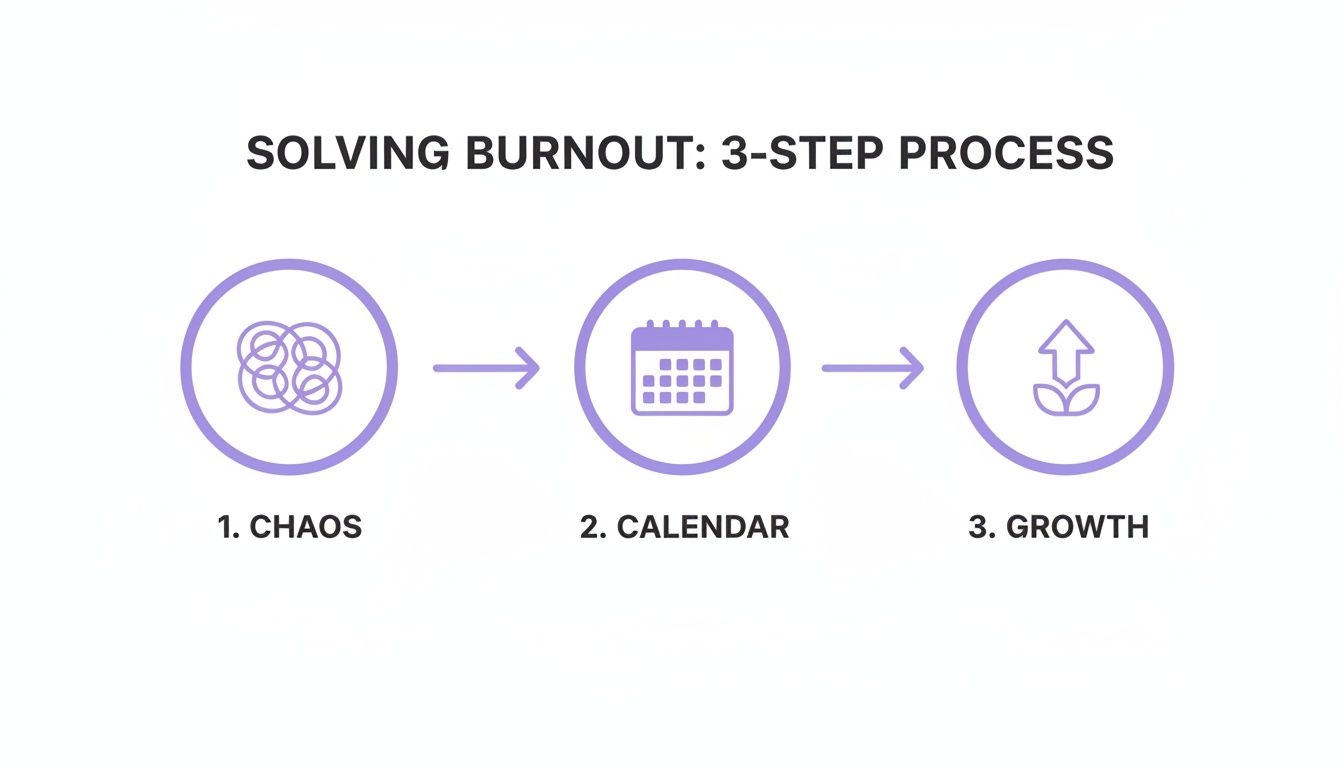
This process shows exactly how a simple calendar can turn disorganized energy into consistent, upward momentum. Ready to build yours?
Step 1: Define Your Goals and Content Pillars
First things first: before you plan what to post, you have to know why you're posting in the first place. Are you trying to get more eyes on your brand? Drive traffic to your website? Generate leads? Your goals are the North Star for every piece of content you create.
With your goals set, it's time to establish your content pillars. These are the 3-5 core topics you’ll talk about over and over again. For a financial advisor, the pillars might be "Investing Basics," "Retirement Planning," and "Market News." Pillars keep your content focused and help you build authority in your niche.
Step 2: Choose the Right Tool
Your calendar is your command center, so picking the right one is a big deal. The good news? You don’t need some hyper-complex system to get started. The best tool is the one you’ll actually stick with.
Deciding between a simple spreadsheet and a dedicated platform can be tough. It really boils down to your team size, workflow complexity, and budget. Here’s a quick comparison to help you figure out what's right for you.
Spreadsheet vs. Dedicated Tool: Which Is Right for You?
Feature | Spreadsheet (e.g., Google Sheets) | Dedicated Tool (e.g., Beplan) |
|---|---|---|
Cost | Free or low-cost | Monthly subscription fee |
Setup | Quick and easy, highly customizable | Some initial setup, but offers guided onboarding |
Collaboration | Basic sharing and commenting | Advanced team workflows, assignments, and approvals |
Visuals | Grid-based, limited visual planning | Drag-and-drop calendars, Kanban boards, post previews |
Integrations | Manual, requires third-party tools (Zapier) | Built-in integrations with social platforms |
Best For | Solo creators, small teams, or beginners on a budget | Growing teams, agencies, and creators needing efficiency |
Spreadsheets are fantastic for getting started—they're free and flexible. But as your content strategy grows, you'll feel the friction. A dedicated tool like Beplan is built for this specific job, making collaboration and visual planning a whole lot smoother.
For a deeper dive, check out our guide on how to use a content calendar template for smooth social media planning. It's packed with practical frameworks you can use right away.
Step 3: Audit Your Existing Content
Don't you dare start from a blank slate. Your past content is a goldmine of data just waiting to be analyzed. Take a look at what you’ve already published. What topics got the most love? Which formats drove the most clicks, comments, and shares?
This isn't just about patting yourself on the back for past wins. This analysis reveals the gaps in your strategy. Maybe you've been ignoring a key pillar, or you realize you haven’t posted a video in months. Use these insights to double down on what works and shore up your weaknesses.
Step 4: Map Out Your Cadence and Content Mix
Now for the fun part—deciding how often to post and what kind of stuff to share. Your posting cadence (or frequency) is all about what you can realistically manage. Remember, consistency is way more important than volume. It’s better to post twice a week without fail than five times one week and zero the next.
Next up is your content mix. A balanced mix keeps your audience engaged and prevents you from sounding like a broken record. A solid framework to start with is:
60% Educational Content: Posts that teach your audience something, solve a problem, or offer valuable insights.
20% Promotional Content: This is where you talk about your products, services, or special offers.
20% Community-Focused Content: Think behind-the-scenes glimpses, user-generated content, or fun posts that get people talking.
Step 5: Start Populating Your Calendar
Okay, your strategy is locked and loaded. It's time to start filling in the blanks. Begin by plugging in the easy stuff: major holidays, industry events, and planned campaign launches.
Then, start brainstorming ideas for each of your content pillars. A Kanban board or even a simple list works great for this. Once you have a bank of ideas, start dragging and dropping them onto specific dates in your calendar. For each piece of content, be sure to include the essential details: topic, format, channel, and status. This is the moment your abstract strategy becomes a concrete, actionable plan.
Turning Your Calendar Into a Growth Engine
A content calendar shouldn't just be a static schedule where ideas go to wait. Its real power is unlocked when it becomes a dynamic tool for growth—a living document that connects your planning efforts directly to your performance.
It's all about transforming it from a simple organizational tool into a data-driven engine for optimization. The key is to create a powerful feedback loop: you plan, publish, analyze what happened, and then refine your future strategy based on those results.
Instead of guessing what works, you use real data to make smarter decisions about your next posts. This simple shift turns your calendar into a strategic asset for continuous improvement.
From Planning to Performance
A growth-oriented calendar moves beyond just tracking deadlines. It weaves key performance indicators (KPIs) directly into your workflow. Imagine seeing which posts generated the most engagement, reach, or clicks right next to the posts themselves. This immediate feedback helps you spot patterns you might otherwise miss.
For example, you can use your calendar to run simple A/B tests. Try posting a video on Tuesday and a carousel on Wednesday, both covering similar topics. Track the results right there in the calendar and let the data tell you which format resonates more with your audience for that type of content.
This proactive approach to analysis is what separates high-performing creators from those who are just guessing.
Your content calendar should answer two critical questions: "What are we publishing next?" and "What did we learn from what we just published?" When it does both, it becomes your most powerful tool for growth.
Using Data to Inform Future Content
Putting this into practice turns social media from a reactive, day-to-day task into a measurable workflow that supports genuine performance optimization. This is essential, especially when you consider that 72–73% of global consumers now use social platforms to research brands before making a purchase.
By tracking outcomes, marketers can identify that an educational post published midweek at 10 AM delivers 25–40% higher engagement, using that insight to shape future schedules. You can read more about how brands and creators are using content scheduling on influenceflow.io.
Platforms like Beplan build this logic directly into the calendar. Features like Smart Insights and a Post Quality Score automatically analyze your last 90 days of performance to give you actionable advice. This automated analysis tells you what timing, captions, and content types are driving the best results, turning your calendar into an intelligent feedback loop.
It's no longer just about scheduling; it’s about scheduling smarter.
Common Content Calendar Questions Answered
Even with the best plan, real-world questions pop up the minute you start using a content calendar. Getting the answers right is what turns your calendar from a simple spreadsheet into a powerful workflow engine.
Let’s tackle some of the most common questions to clear up any confusion and get you managing your content like a pro.
How Far in Advance Should I Plan Content?
This is the big one. While the perfect window depends on your industry and team, a fantastic rule of thumb is to work one month ahead. In practice, this means your entire April calendar should be locked in by the first week of March.
Why one month? It hits the sweet spot.
It’s long enough to give you breathing room. No more last-minute scrambling. You'll have plenty of time for proper reviews and for producing bigger assets like videos.
It’s short enough to stay agile. Planning six months out is a recipe for wasted effort. Market trends, audience interests, and platform algorithms can change on a dime.
Of course, for huge campaigns or product launches, you’ll want to look further out—think 3-6 months to coordinate all the moving parts. But for your day-to-day content, a one-month rolling calendar keeps you both organized and ready to adapt.
What About Spontaneous or Trending Topics?
A lot of people worry that a content calendar will box them in, making their content feel stiff or preventing them from jumping on a viral trend. But a good calendar provides structure, not a straitjacket. The trick is to build flexibility right into your schedule.
One simple and effective way to do this is to pencil in "flex slots" each week. Maybe you leave Tuesday afternoon or Friday morning open for a post that’s planned but not finalized.
Think of your content calendar as a ship's planned route, not a train on a fixed track. You have a clear destination, but you reserve the right to make smart detours to catch favorable winds (or trending topics) along the way.
When a massive trend takes off, you can drop it into a flex slot without derailing your entire week. And if it's a quiet week? No problem. Just use that spot for one of your evergreen or "nice-to-have" ideas. You get consistency without ever missing an opportunity.
Content vs. Social Media vs. Editorial Calendars
You'll hear these terms thrown around, sometimes interchangeably, but they each have a specific job. Nailing the difference helps you pick the right tool for your needs.
Here’s a simple way to think about it:
Calendar Type | Primary Focus | What It Contains |
|---|---|---|
Content Calendar | The high-level, strategic view of all content. | The master plan: blog posts, videos, podcasts, case studies, social campaigns, and email newsletters all live here. |
Social Media Calendar | The day-to-day schedule for social platforms only. | The nitty-gritty: specific post copy, visuals, hashtags, tags, and exact publishing times for Instagram, X, etc. |
Editorial Calendar | The production workflow for long-form content. | Tracks stages for blogs and articles, like outlining, drafting, editing, and SEO review. It's all about workflow. |
Think of it like a set of nesting dolls. The overarching content calendar is the biggest doll that holds everything. Tucked inside, you’ll have a more detailed social media calendar and a separate editorial calendar for your blog team.
Ready to stop scrambling and start strategizing? Beplan transforms your content planning from a chaotic spreadsheet into a streamlined, collaborative command center. With a drag-and-drop calendar, smart insights, and seamless approvals, you can finally focus on creating, not just organizing. Start your free Beplan trial today and build a better content workflow.
Related articles
Our platform is designed to empower businesses of all sizes to work smarter and achieve their goals with confidence.