
How To
Friday, January 9, 2026
How to plan social media content: A Simple Framework for Consistent Posts
Discover how to plan social media content with a practical framework for pillars, calendars, and systems that boost engagement and growth.
Before you even think about what to post next week, you need to pour the foundation. A winning social media plan isn't built on random ideas and last-minute scrambling; it’s built on a solid, strategic base. This initial groundwork is what separates the brands that get real results from those just shouting into the void.
It all starts with getting crystal clear on your goals, taking an honest look at what you’re already doing, and truly understanding who you’re talking to. Get these three things right, and every single piece of content you create will have a purpose.
Building Your Foundation for a Winning Social Plan
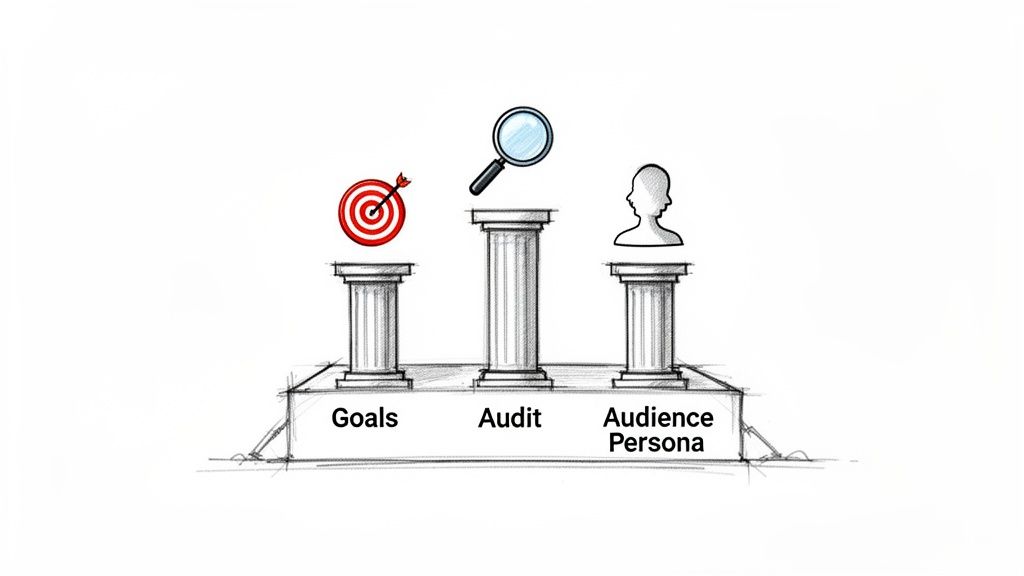
Let's be real: without a plan, you're just posting. But with a solid foundation, you’re building an asset for your business. This is about making sure every video, image, and caption you share is intentional and moves the needle on what actually matters.
The first step? Defining what success even looks like for your brand.
Define Sharp, Measurable Objectives
Goals like "get more followers" or "increase engagement" are fluffy and unhelpful. They don't give you a target to aim for or a way to know if you're actually winning. You need to get specific.
Think in terms of tangible business outcomes. A much stronger goal sounds like, "Increase website traffic from Instagram by 15% in the next quarter" or "Generate 25 qualified leads per month from LinkedIn." See the difference? Now you have a real benchmark.
To figure out your own goals, ask yourself what you really want social media to do for your business. Are you trying to:
Build Brand Awareness: Get your name in front of a new audience or increase how often people are talking about you.
Boost Community Engagement: Spark conversations, build relationships, and create a loyal group of fans.
Drive Website Traffic and Leads: Move people from your social profiles to your website to make a purchase or sign up.
Nailing down these objectives gives you the "why" behind your entire content strategy.
Conduct an Honest Social Media Audit
Next up, you need a clear, unfiltered look at your current performance. A social media audit isn't about feeling bad about what's not working; it's a data-gathering mission to find out what is working and where the hidden opportunities are.
Dive into the analytics for every platform you're on. Look for the standouts in your top-performing content. Which posts got the most likes, comments, shares, and saves? What topics or formats consistently get a reaction? You might find that your silly, behind-the-scenes Reels on Instagram get way more love than your polished quote graphics. That's gold.
Key Takeaway: An audit replaces guesswork with facts. It helps you stop throwing content at the wall to see what sticks and start creating things you know your audience is hungry for.
Part of this process is also peeking at what your competitors are up to. What are they doing well? More importantly, what are they not doing? If everyone in your niche is posting serious, educational carousels, maybe there's an opening for a more humorous, personality-driven approach. This is how you find your lane and stand out.
Craft Detailed Audience Personas
This final piece of the foundation is arguably the most important: getting inside the heads of your followers. Basic demographics like age and location are just the starting point. They don’t tell you what makes your audience tick.
To create personas that actually help, you have to go deeper into their psychographics. Spend some time answering these questions to paint a full picture:
What are their biggest frustrations and challenges in life or work?
What are their dreams and aspirations?
What kind of content do they actually find useful, inspiring, or just plain fun?
Where do they hang out online, and what's their vibe on each platform?
Let's say you're a financial advisor targeting millennials. A demographic profile is "25-35, lives in a city, has a degree." A persona, on the other hand, is "Meet 'Savings-Focused Sarah,' a 29-year-old marketing manager who’s totally overwhelmed by investing jargon. She scrolls Instagram for simple, bite-sized tips that can help her build wealth without making her feel dumb."
That level of detail changes everything. Now you're not just creating content for "millennials"—you're creating content specifically for Sarah.
Establishing Your Core Content Pillars and Idea Engine
Alright, you know your goals and who you're talking to. Now it's time to build the actual engine that will pump out a steady stream of content ideas. This is the secret to moving beyond the "what should I post today?" scramble and creating a repeatable system that just works.
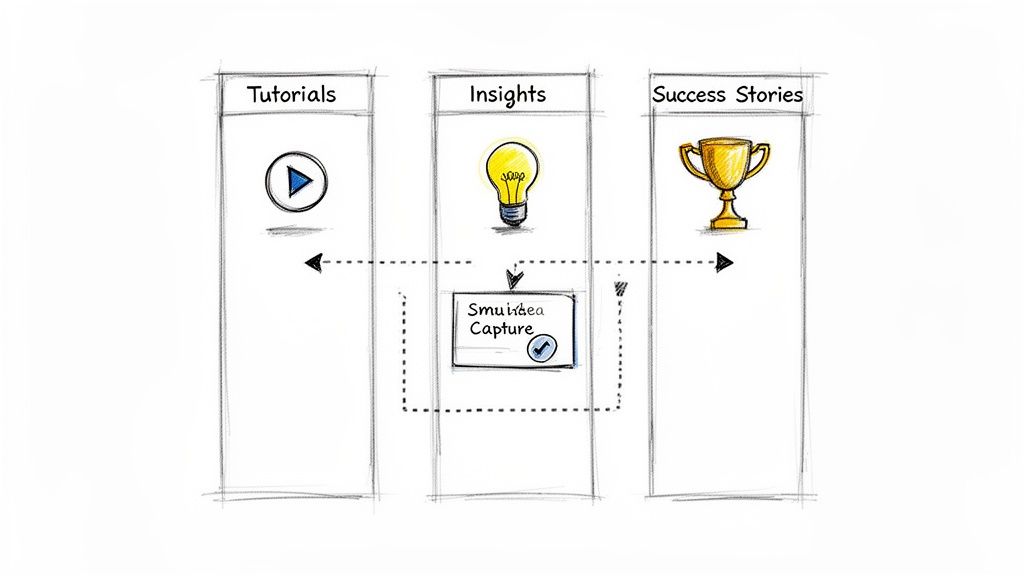
The heart of this engine is a set of core content pillars. Think of these as the 3-5 big themes your brand will own. They're the guardrails that keep your content focused, relevant, and consistently aligned with what your audience is hungry for. Everything you post should ladder up to one of these pillars.
Defining Your Core Content Pillars
Your pillars should live at the intersection of your audience's problems and your unique expertise. They’re the topics you want to become the go-to resource for in your followers' minds.
A great starting point is to brainstorm broad categories based on your audience research and then get more specific. For instance, a financial advisor targeting freelancers might land on these pillars:
Freelance Tax Tips: Practical advice on deductions, quarterly payments, and navigating the confusing world of self-employment taxes.
Investing for Beginners: Demystifying stocks, retirement accounts, and how to build long-term wealth without a traditional 9-to-5.
Client Management & Pricing: Business-focused content on things like contracts, setting your rates with confidence, and managing cash flow.
Success Stories: Showcasing clients who’ve hit their financial goals, which provides both inspiration and powerful social proof.
With a structure like this, you have a clear roadmap. Stuck for an idea? Just look at your pillars and ask, "What can I create for the 'Investing for Beginners' bucket today?"
Pro Tip: Your content pillars should directly solve the pain points you uncovered in your audience persona research. If "Savings-Focused Sarah" feels overwhelmed by financial jargon, a pillar dedicated to simplifying complex topics is a perfect match.
To give you a better idea of how this works across different industries, here’s a look at how various creators and businesses might structure their pillars.
Example Content Pillars for Different Niches
Niche/Industry | Content Pillar 1 (Educate) | Content Pillar 2 (Inspire) | Content Pillar 3 (Entertain) | Content Pillar 4 (Promote) |
|---|---|---|---|---|
Fitness Coach | "How-To" workout tutorials, nutrition tips, explaining the science of muscle growth. | Client transformation stories, motivational quotes, sharing personal fitness journey. | Funny gym fails (relatable), workout memes, behind-the-scenes bloopers. | New coaching program announcements, client testimonials, free workout plan downloads. |
SaaS Company | Step-by-step guides on using specific features, industry best practices, data-driven insights. | Case studies of customer success, interviews with industry leaders, future of the industry posts. | Relatable office humor, team-building activity highlights, "day in the life" of an employee. | Product update announcements, webinar invitations, free trial offers, demo requests. |
Travel Blogger | Budget travel hacks for specific destinations, packing guides, "what to avoid" lists. | Stunning travel photography, personal stories of discovery, bucket list destination ideas. | Funny travel mishaps, cultural quirks observed abroad, "expectation vs. reality" posts. | Affiliate links for travel gear, promoting a custom itinerary service, sponsored hotel reviews. |
Real Estate Agent | Explaining the mortgage process, tips for first-time homebuyers, local market analysis. | "Dream home" tours, stories of families finding their perfect house, neighborhood spotlights. | Hilarious Zillow listings, staging before-and-afters, common real estate myths busted. | New property listings, open house announcements, client success stories (sold over asking!). |
As you can see, these pillars provide a balanced diet of content that serves the audience in different ways while still aligning with the brand's ultimate goals.
Building Your Idea Engine
Once your pillars are defined, you need a system to keep them fueled. An "idea engine" is just a fancy name for a simple, structured workflow for capturing, organizing, and developing your content concepts. This is what turns content planning from a reactive chore into a proactive, creative habit.
A messy pile of screenshots and random notes just won't cut it. You need a system that's so easy you'll actually use it. A Kanban-style board is perfect for this. Tools like Trello, Asana, or even the idea management features in a platform like Beplan work beautifully.
Create a few columns to represent your content workflow:
Idea Inbox: This is your brain dump. Every time an idea pops into your head, you see a competitor's post you like, or you read a cool article, drop it here. No filtering, no judging.
Developing: Drag promising ideas from the inbox into this column. Here's where you can start to flesh them out, find a relevant stat, or outline the main talking points.
Ready to Create: Once an idea is fully baked, it moves here. This is the green light for your creative team (or you!) to start writing, filming, or designing.
Scheduled: The post is made, polished, and slotted into your content calendar.
Published: The finish line! This column serves as an archive, which you can revisit later to see what performed well and why.
Actively Sourcing New Ideas
Your idea engine needs fuel to run, so you have to be intentional about sourcing inspiration. Block off a little time each week to actively hunt for ideas that fit your pillars. This keeps your content fresh and prevents you from ever hitting a creative wall.
Here are a few goldmines for new ideas:
Social Listening: Keep an eye on keywords related to your pillars. What are people asking on Reddit, Quora, or in niche Facebook groups? Their questions are your future content.
Competitor Analysis: See what's working for others in your space. Don't copy their posts, but look for the underlying topics and formats that resonate with your shared audience.
Customer Feedback: Your own DMs and comment sections are an absolute goldmine. If someone asks a question, chances are ten other people have the same one. Turn it into a post.
Industry News: Subscribe to a few key newsletters or publications in your field. Being the first to comment on a new trend positions you as an expert.
This systematic approach—defining pillars and building an idea engine—is the foundation of a stress-free content plan. It provides the structure you need to be consistently creative and ensures you'll never stare at a blank calendar again.
Building Your Content Calendar and Workflow
You've got your strategy locked in and ideas are flowing. Now for the fun part: turning all that thinking into a real, tangible plan. This is where you build the operational backbone of your social media—the content calendar and workflow that transforms random posting into a smooth, predictable process.
A good calendar is way more than just a schedule. It's your strategic command center, ensuring you stay consistent, avoid burnout, and get that crucial bird's-eye view of your entire content story. It lets you plan with purpose, making sure you hit all your content pillars.
Find Your Ideal Posting Cadence
One of the first questions I always get is, "How often should I be posting?" And the honest-to-goodness answer is: it depends. There’s no magic number. The right posting cadence is simply the one you can sustainably maintain with high-quality content.
Consistency beats frequency, every single time. It's so much better to share three incredible, value-packed posts a week than to push out seven rushed, mediocre ones. Your audience rewards quality and reliability, not just volume. Start with a pace that feels comfortable, then watch your analytics. You can always scale up later when you have the bandwidth.
Interestingly, most teams aren't planning months in advance. Recent data shows that about 38% of marketers plan their social media content just one to two weeks ahead. But the pressure to post is still high, with 20% of marketers publishing content more than once a day. If you want a deeper dive into what's happening in the social media world, you can explore the full social media statistics report.
Key Insight: A content calendar isn't a prison. Think of it as a flexible blueprint. It gives you the structure you need for long-term planning but leaves you plenty of room to jump on real-time trends and conversations.
To get this schedule built, I'd recommend a digital tool over a simple spreadsheet. Dedicated platforms are just built for this stuff. If you're looking for a quick start, check out our guide on how to use a content calendar template for smooth social media planning.
Master the Art of Content Batching
Content batching is a total game-changer for productivity. The idea is simple: instead of creating one post at a time, you block out a chunk of time to create a bunch of content at once. It's like meal prepping for your social media feed.
So, instead of writing a caption on Monday, filming a Reel on Tuesday, and designing a graphic on Wednesday, you do all your writing in one session. All your filming in another. All your design work in a third. This "task batching" saves a ton of mental energy by cutting down on context switching.
Here’s what a typical batching workflow might look like:
Planning Session (1-2 hours): Look at your content pillars and pick out the specific post ideas for the next week or two.
Writing Session (2-3 hours): Crank out all the captions, video scripts, and text overlays for your chosen posts.
Visuals Session (3-4 hours): Film all your videos, shoot your photos, and design your graphics in one fell swoop.
Scheduling Session (1 hour): Upload everything into your scheduling tool, tweak the captions for each platform, and set them to go live.
By dedicating one solid day or a few focused blocks of time to this, you can knock out an entire week's—or even a month's—worth of content. This frees you up to focus on what really matters: engaging with your community and thinking about the bigger picture.
Tailor Your Content for Each Platform
Batching is efficient, but it's not an excuse to post the exact same thing everywhere. A "one-size-fits-all" strategy just doesn't work. It ignores the unique culture and what users expect on each platform. What absolutely crushes it on TikTok can fall completely flat on LinkedIn.
The trick is to adapt, not just duplicate. Your core idea or message stays the same, but you change up the execution for each channel.
Let's say your core idea is a "Client Success Story." Here’s how you could tailor it:
LinkedIn: You'd write a text-focused post with a professional headshot of the client. The copy would zero in on the business challenges, the solution you provided, and the hard numbers—like, "Increased lead generation by 40%."
Instagram: A multi-image carousel would be perfect. The first slide could feature a killer quote from the client. The next few slides could walk through their journey with eye-catching graphics, ending with a clear call-to-action in the caption.
TikTok/Reels: A short, snappy video is the way to go here. Feature the client talking directly to the camera about their transformation. You’d use trending audio and on-screen text to highlight the key takeaways in a way that feels native to the platform.
This approach lets you be efficient while still respecting the nuances of each audience. And that's what makes a social media plan truly effective.
Create and Repurpose Content at Scale
The secret to a never-ending stream of high-quality posts isn't coming up with something brand new every single day. The real key? Mastering the art of content repurposing.
It’s all about working smarter, not harder, by squeezing every last drop of value from your best ideas.
This is where a strategy called content atomization comes in. You start with one large, foundational piece of content—your "pillar" asset—and strategically break it down into dozens of smaller, bite-sized assets perfect for social media. This method massively boosts your output without draining your creative energy.
From One Big Idea to Many Small Posts
Think about a single, value-packed webinar you recently hosted. Instead of letting that recording collect dust, you can atomize it. That one-hour session can become a goldmine of social media content that fuels your calendar for weeks.
For example, that single webinar could be turned into:
Five short video clips for Instagram Reels and TikTok, each highlighting a single powerful tip.
A ten-part Twitter thread that summarizes the key takeaways in a quick, scannable format.
An insightful LinkedIn carousel that visualizes the main data points and frameworks discussed.
A series of quote graphics for Instagram and Facebook, featuring the most impactful lines from the presentation.
Suddenly, one piece of work has generated nearly twenty unique social media posts. This isn't just about saving time; it's about reinforcing your core messages across different platforms and formats to reach a much wider audience. For more practical approaches, check out these content repurposing ideas for busy creators.
Key Takeaway: Stop thinking of content as a one-and-done activity. Every blog post, podcast episode, or case study is a potential source for dozens of smaller pieces of content. Your job is to find the hidden gems and give them new life.
This is how different workflow strategies—like setting a consistent cadence, batching tasks, and tailoring content—all click together to support a scalable plan.
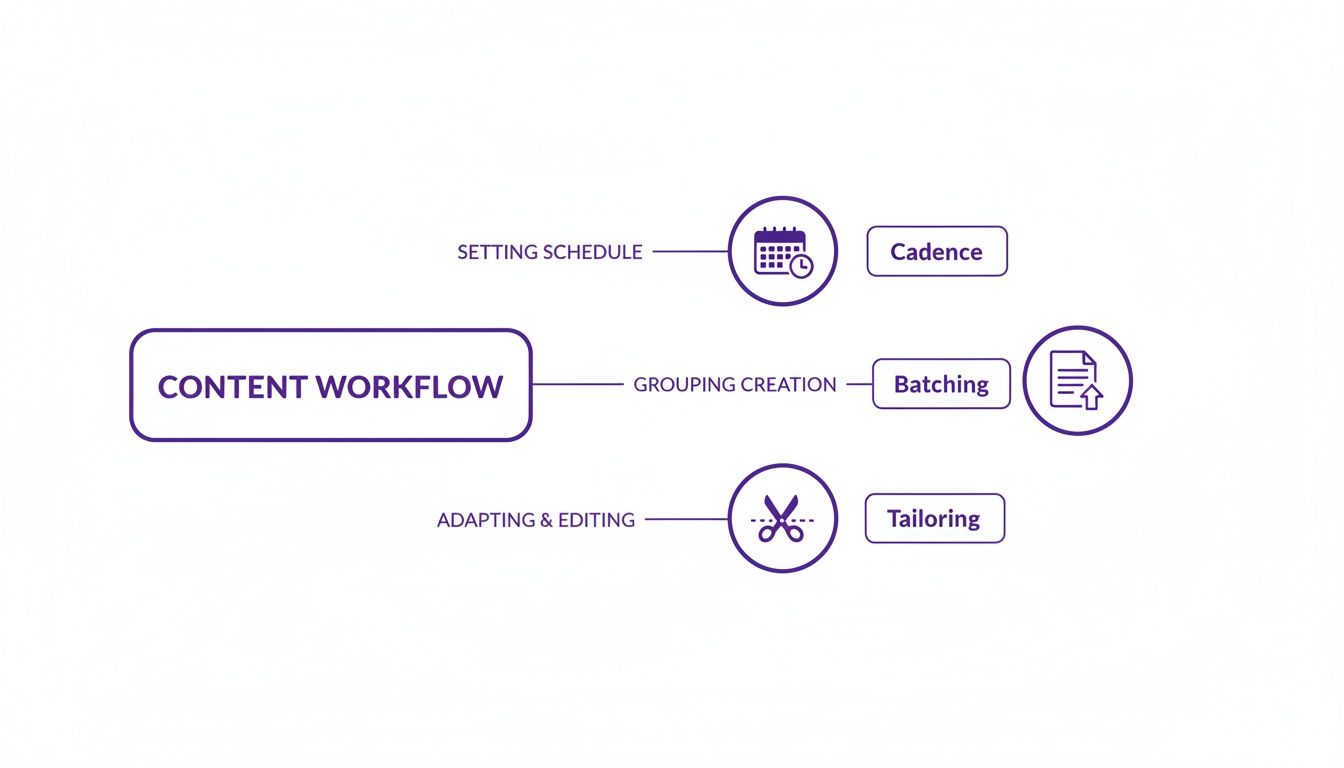
This workflow shows that great social media planning is a cycle: you schedule, you create efficiently, and you adapt your message for each platform.
Building Repurposing Into Your Plan
The best way to manage this is to build repurposing directly into your content planning from the very beginning. When you're outlining a new blog post, don't just think about the article itself. Start brainstorming the social media assets you can pull from it at the same time.
Try creating a simple checklist for every major piece of content you produce.
Content Type | Potential Repurposed Assets |
|---|---|
Blog Post | - Pull-quote graphics |
Podcast | - Audiogram clips for social feeds |
Case Study | - Client testimonial video clip |
This structured approach turns repurposing from an afterthought into a core part of your workflow. You'll spot opportunities more easily and make sure no valuable insight gets left behind.
Spotting Repurposing Opportunities
Developing an eye for repurposable moments is a skill. As you review your own long-form content, actively hunt for those "nuggets" of value that can stand completely on their own.
Here’s what to look for:
Powerful Statistics: Any compelling number can be turned into a striking graphic or a quick video. For instance, a stat like "72.3% of users research brands on social media" is a perfect standalone post.
Actionable Tips or Steps: If you outline a three-step process in a video, each step can become its own individual post in a carousel or a series of Stories.
Memorable Quotes: A single, impactful sentence can be incredibly powerful. Pull these out and feature them in a clean, branded graphic.
Frequently Asked Questions: The Q&A section of a webinar is a treasure trove. Each question and its answer can be a dedicated post that solves a real audience pain point.
By integrating this mindset into your planning, you create a sustainable system that delivers consistent value. You’ll find your calendar is always full, your messaging is cohesive, and your creative efforts have a far greater impact.
Measuring Performance to Optimize Your Plan
Your social media plan isn't a static document you create once and file away. Think of it as a living, breathing blueprint that needs to adapt to what your audience is actually responding to. This final step is all about closing the loop—using real data to turn a good plan into a great one.
This is where you stop guessing and start knowing. By consistently checking in on your performance, you can confidently double down on what works and cut what doesn't, making sure your efforts are actually hitting your most important business goals.
Shifting Focus to Metrics That Matter
First things first: we need to look past the vanity metrics. A high follower count or a flood of likes can feel good, but they don't always translate into business results. Instead, your focus should be on data that signals a real connection with your audience and prompts them to take action.
These are the metrics that actually move the needle:
Engagement Rate: This is the percentage of your audience that interacts with your content. It’s a far better sign of a healthy community than follower count because it proves people are actively listening and responding.
Website Clicks: This one is straightforward—it measures how many people are moving from your social profile to your website. It’s a direct link between your social efforts and potential leads or sales.
Shares and Saves: These are high-intent signals. A share means someone found your content so valuable they became a brand advocate. A save indicates they see it as a resource they want to come back to later.
Conversions: For many, this is the ultimate goal. Tracking how many users complete a specific action—like signing up for a newsletter or making a purchase—proves the direct ROI of your social strategy.
Planning your content around this kind of data is no longer just a best practice; it has a direct impact on revenue. With 72.3% of online audiences now using social media for brand research, your feed is often a customer's first impression.
Establishing a Regular Review Cadence
Data is useless if you don't act on it. The key is building a simple, repeatable review process right into your workflow. You don’t need a complex system; a weekly or monthly check-in is often perfect.
Block out a recurring time on your calendar to dive into your analytics. During this review, your goal is to answer a few key questions about the previous period:
Which content pillar drove the most engagement? Did your educational tutorials outperform your inspirational success stories? This tells you what your audience is hungry for.
What content format performed best? Did Reels get more reach than carousels? Did simple text posts on LinkedIn spark more conversation than videos?
Which specific posts were top performers? Look at your top three posts and dissect them. What was the hook? The call-to-action? The visual style? See if you can spot a pattern.
What were the optimal posting times? Most platforms provide data on when your audience is most active. Check if your posting schedule aligns with these peak hours for maximum visibility.
Key Takeaway: A consistent review cycle transforms your social media plan from a static to-do list into a dynamic feedback loop. Each review provides fresh insights that make your next round of content even smarter and more effective.
Translating Insights Into Actionable Steps
The final piece of the puzzle is turning your analysis into concrete actions for your next content plan. This is where data meets strategy. Your findings should directly inform what you create next.
Here’s how that might look in a real-world scenario. Let's say your monthly review reveals the following:
Insight: Your "Behind-the-Scenes" content pillar consistently gets the highest engagement rate.
Action: For the next month, you decide to increase the frequency of behind-the-scenes posts from once a week to twice a week.
Here's another example:
Insight: A long, text-heavy LinkedIn post about a common industry mistake went unexpectedly viral, generating more website clicks than any other post.
Action: You decide to test more long-form, opinionated text posts on LinkedIn. You also plan to repurpose that winning post's core idea into a short video for Instagram and a Twitter thread.
For those looking to dig deeper into their data, it's worth exploring tools that go beyond the native analytics offered by each platform. To help you choose the right one for your needs, we have a detailed guide on the best social media analytics tools beyond standard metrics.
By making these small, data-backed adjustments month after month, you create a powerful compounding effect. Your content gets progressively more aligned with what your audience wants, leading to stronger engagement, faster growth, and a social media strategy that reliably delivers results.
Got Questions? We’ve Got Answers.
Even with the best plan, you're bound to run into a few questions once you're in the thick of it. Planning out social media content always brings up a few common hurdles. Here are our answers to the ones we hear most often.
Think of this as your quick-reference guide for getting unstuck and moving forward with confidence.
How Far Ahead Should I Plan My Content?
For most brands, planning two to four weeks in advance is the sweet spot.
That gives you enough runway to batch content, get any necessary approvals, and line everything up with your bigger marketing campaigns. You’re not just scrambling day-to-day.
But it’s also not so far ahead that you’re locked into a rigid schedule months from now. This is key. You need enough breathing room to jump on a breaking trend, join a viral conversation, or pivot if something unexpected happens. A one-month planning cycle really does strike the perfect balance between proactive strategy and reactive relevance.
What Are the Best Tools for Content Planning?
Honestly, the "best" tool completely depends on your workflow and team size. There's no one-size-fits-all answer here, but we can break it down.
For Solo Creators or Small Teams: Keep it simple. Seriously. A well-organized spreadsheet or a Kanban board in a tool like Trello can be more than enough to track ideas and manage a basic schedule without overcomplicating things.
For Growing Brands and Agencies: This is where dedicated social media management platforms like Beplan really start to pay off. You get a visual calendar, an idea bank, collaboration features, and analytics all in one spot. This stops the chaos of jumping between five different apps and keeps the entire workflow—from idea to post—in one place.
The right tool should feel like it's removing friction from your process, not adding another layer of complexity. It should make it easier to organize ideas, work with your team, and see your plan at a glance.
How Do I Plan if I Have No Idea What My Audience Wants?
If you're just starting out or feel like you're posting into the void, your first content plan is really just one big experiment. And that's okay! Your job is to listen and test a few educated guesses.
Start by digging into your existing analytics. Look for any past posts—even ancient ones—that got a flicker of engagement. What was the topic? The format? Then, go snoop on your direct competitors. What are their most popular posts? What topics get people talking in their comments?
Most importantly, just ask your audience directly. Use Instagram Stories polls, drop open-ended questions in your captions, and create content that literally invites them to share their opinions.
Your first one-month plan should be a mix of different formats and topics based on this research. After that month, look at the data. See what actually worked, and then double down on those winning themes for your next plan.
Ready to build a content plan that gets results without the chaos? Beplan offers an intuitive calendar, powerful collaboration tools, and smart analytics to turn your strategy into action. Start planning smarter for free at Beplan.
Related articles
Our platform is designed to empower businesses of all sizes to work smarter and achieve their goals with confidence.