Monday, January 12, 2026
8 Social Media Content Calendar Examples to Streamline Your 2026 Strategy
Discover 8 proven social media content calendar examples and templates. Learn how to plan, schedule, and optimize your strategy for maximum engagement in 2026.
Tired of the last-minute scramble to find something, anything, to post on social media? That constant demand for fresh, engaging content can lead to burnout, inconsistency, and lackluster results. The solution isn't to work harder; it's to plan smarter with a system that removes the daily guesswork and stress from your workflow.
A well-structured social media content calendar transforms your strategy from a reactive, chaotic task into a proactive, long-term asset. It’s the critical difference between posting randomly and building a predictable engine for audience growth and community engagement. More than just a schedule, it’s a strategic roadmap that ensures every post has a purpose, aligns with your goals, and contributes to a cohesive brand narrative. This clarity allows you to focus on creating high-quality content instead of just filling a quota.
This guide moves beyond generic templates. We are diving deep into eight real-world social media content calendar examples, breaking down the exact strategy behind each one. You'll learn not just what to post, but why, when, and how to adapt these proven frameworks for your specific brand or clients. We’ll explore everything from pillar and cluster models to data-driven performance calendars, giving you actionable takeaways for each. Finally, we’ll show you how to implement these strategies in a modern scheduler to save time, optimize performance, and turn your content plan into a powerful, automated system. Let's get started.
1. The 80/20 Content Mix Calendar
The 80/20 Content Mix Calendar is a strategic framework built on the Pareto Principle, also known as the 80/20 rule. In this context, it dictates that 80% of your content should provide value to your audience by educating, entertaining, or engaging them. The remaining 20% is reserved for direct promotion or sales-oriented messages. This balance prevents audience fatigue from constant selling and builds a loyal community that trusts your brand, making them more receptive when you do present an offer.
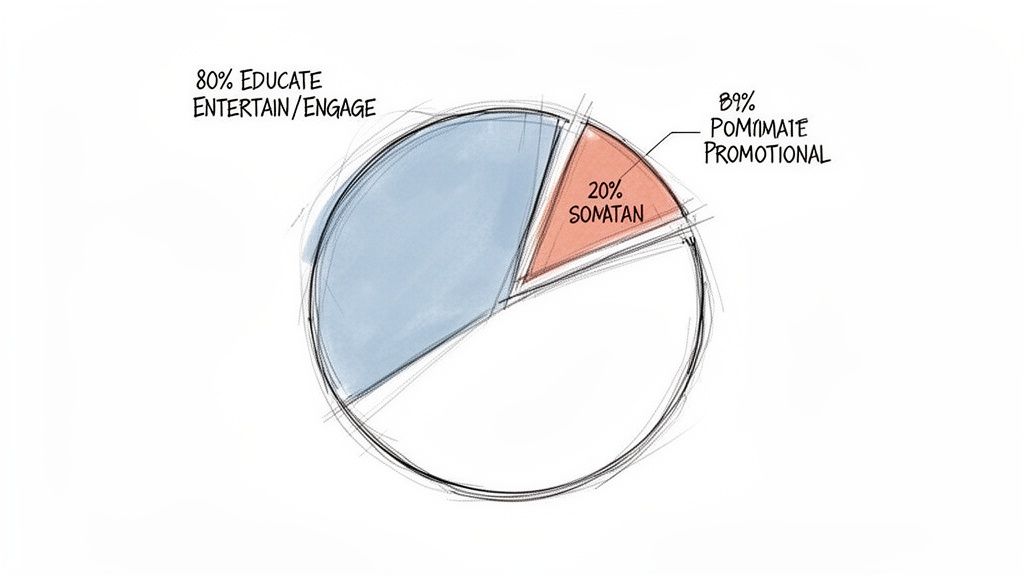
This approach is one of the most effective social media content calendar examples because it prioritizes long-term relationship building over short-term sales. Think of HubSpot’s strategy; they primarily share valuable blog posts, free tools, and educational resources. Only a small fraction of their content directly pushes for a demo or paid subscription. This value-first model establishes them as an industry authority, naturally drawing customers in.
Strategic Breakdown and Use Case
This calendar is ideal for brands focused on building community, establishing thought leadership, and nurturing leads over time. It works exceptionally well for service-based businesses, educators, and creators who need to build trust before a transaction.
When to Use: Ideal for long-term brand building, audience nurturing, and avoiding an overly "salesy" social media presence.
Best For: B2B companies, consultants, coaches, and brands with longer sales cycles.
Frequency: Typically planned on a monthly or quarterly basis. For every five posts, four should be value-driven, and one can be promotional.
Actionable Takeaways for Implementation
To implement this model effectively, you must clearly define your content categories.
**Key Approach:** Utilize a Kanban board view in a tool like Beplan to design formats for your content categories: 'Educate,' 'Entertain,' 'Engage,' and 'Promote.' By applying these formats to your media, posts, and posting slots, you can easily filter the Kanban by format to ensure you are adhering to the 80/20 ratio at a glance.
Here are steps to put this calendar into action:
Define Your Pillars: Identify 3-5 core topics your audience cares about. These will form the foundation of your 80% value-driven content.
Batch Create Content: Dedicate specific blocks of time to create your "80%" content. This includes writing scripts, designing graphics, or recording videos for multiple posts at once.
Schedule Strategically: Use a scheduler's analytics to identify peak engagement times for your value-driven posts. Save your promotional "20%" content for times when your audience is most likely to take action.
Analyze and Adapt: Regularly review which non-promotional posts drive the most comments, shares, and saves. Double down on those formats and topics to further strengthen audience engagement.
2. The Pillar & Cluster Content Calendar
The Pillar and Cluster Content Calendar organizes your strategy around a central, comprehensive "pillar" topic. This core piece of content is then broken down into numerous smaller "cluster" posts that delve into specific subtopics. Each cluster piece is designed to drive traffic and engagement back to the main pillar, creating a powerful, interconnected web of content that boosts both SEO and social authority.
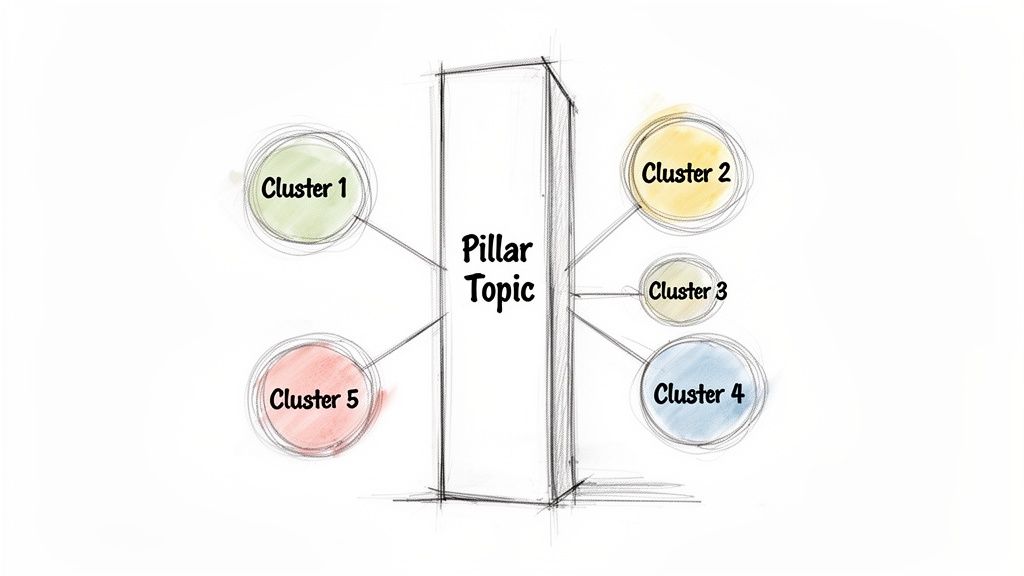
This model transforms a single large idea into a month-long social media campaign. For example, a brand like Semrush might create a pillar guide on "Keyword Research" and then dedicate their social calendar to cluster posts like "How to Find Long-Tail Keywords," "Top 5 Keyword Research Tools," and "Understanding Search Intent." This makes it one of the most efficient social media content calendar examples for demonstrating deep expertise.
Strategic Breakdown and Use Case
This calendar is perfect for brands that want to dominate a specific niche and establish themselves as the go-to resource. It streamlines content creation by providing a clear, hierarchical structure, ensuring every post serves a larger strategic purpose.
When to Use: Excellent for building topical authority, improving SEO, and repurposing long-form content for social media.
Best For: B2B SaaS companies, educational brands, and content-heavy businesses aiming for thought leadership.
Frequency: Typically organized around one major pillar topic per month or quarter, with 4-8 cluster posts scheduled throughout that period.
Actionable Takeaways for Implementation
Success with the pillar-cluster model depends on strategic planning and organization. You need a clear map of how each cluster supports the main pillar.
Key Tactic: Use a calendar's month view to visually map out your pillar and cluster content. Designate a color for each pillar campaign and use it to tag all related cluster posts, giving you an instant overview of how your content is distributed over time.
Here are steps to put this calendar into action:
Select Your Pillar: Choose a broad, high-value topic that your audience is searching for and that aligns with your core business offering.
Brainstorm Clusters: Break down your pillar topic into at least 5-8 smaller, more specific subtopics. Each one will become a social media post (or a series of posts).
Vary Content Formats: Turn your cluster ideas into diverse formats like carousels, short-form videos, infographics, and Twitter threads to keep your feed engaging.
Schedule and Link: Plan your cluster posts to be published consistently throughout the month. Always include a call-to-action that directs your audience back to the main pillar content, such as a link in your bio or a direct link in a post.
3. The Seasonal & Event-Based Content Calendar
The Seasonal & Event-Based Content Calendar is a proactive framework built around timely, relevant moments. This model involves planning content 3-6 months in advance, centered on holidays, industry events, product launches, and cultural trends. By anchoring your strategy to these key dates, you can capitalize on existing audience excitement and conversations. The goal is to create content that feels both timely and anticipated.
This approach is one of the most powerful social media content calendar examples for driving timely engagement and sales. Think of Starbucks' strategy for its seasonal product launches like the Pumpkin Spice Latte; their social media builds immense hype weeks in advance, making the launch a cultural event. Similarly, fashion brands like ASOS plan content around seasonal collection drops, aligning social media visuals and messaging with the changing seasons far ahead of time.
Strategic Breakdown and Use Case
This calendar is perfect for businesses with products or services that have a clear seasonal or event-driven appeal. It allows brands to create cohesive, multi-channel campaigns that build momentum and guide customers through a specific purchasing journey, from awareness to conversion.
When to Use: Ideal for tapping into periods of high consumer spending, building hype for launches, and staying culturally relevant.
Best For: E-commerce, retail, food and beverage, and B2C brands whose offerings align with specific times of the year.
Frequency: Planned quarterly or bi-annually. Content production for major events should start 6-8 weeks prior to the launch date.
Actionable Takeaways for Implementation
To succeed with this model, forward planning and visual organization are non-negotiable.
Key Tactic: Use a calendar tool with a month view, like Beplan, to visually map all key dates. Create color-coded categories for 'Holidays,' 'Product Launches,' 'Industry Events,' and 'Cultural Moments' to get a clear overview of your entire strategic timeline.
Follow these steps to put this calendar into action:
Identify Key Dates: Brainstorm and list all relevant global holidays, niche events, and planned company milestones for the next 6-12 months.
Establish Campaign Timelines: For each key date, work backward to set deadlines. Schedule milestones for brainstorming, content creation, approvals, and final scheduling.
Create Thematic Content Clusters: Plan a series of posts around each event. For a product launch, this could include teasers, behind-the-scenes content, user-generated content prompts, and a final launch announcement.
Prepare for Slow Seasons: Identify the quieter periods between major events. Use this time to schedule evergreen content that educates or entertains, ensuring you maintain a consistent presence.
4. The Content Batching & Batch Calendar
The Content Batching & Batch Calendar is a productivity-focused framework designed to streamline content creation by grouping similar tasks. Instead of creating content daily, you dedicate specific, concentrated blocks of time known as "batch days" to produce a large volume of posts at once. The calendar then serves as a repository to schedule this pre-produced content across subsequent weeks or even months. This method is a game-changer for preventing burnout, ensuring a consistent posting schedule, and freeing up time for other strategic tasks.
This approach is one of the most practical social media content calendar examples for busy creators and teams. For instance, many top YouTubers like Emma Chamberlain or MrBeast utilize batching to film multiple videos in single, intensive sessions. This allows them to maintain a consistent upload schedule while managing other business ventures. The core principle is simple: work smarter, not harder, by separating the creation process from the scheduling and publishing process.
Strategic Breakdown and Use Case
This calendar is perfect for anyone who feels overwhelmed by the daily demand for content, from solo creators to entire marketing teams. It transforms content creation from a reactive daily chore into a proactive, systemized process, which significantly improves both the quality and consistency of your output.
When to Use: Ideal for maintaining a high-volume posting schedule without daily creative pressure, increasing efficiency, and ensuring you always have content ready to go.
Best For: Solo entrepreneurs, small business owners, YouTubers, podcasters, and social media managers handling multiple accounts.
Frequency: Content creation is batched in intensive sessions (e.g., one full day per month or a few hours each week), while scheduling is done to fill the calendar for the upcoming 2-4 weeks.
Actionable Takeaways for Implementation
To succeed with batching, you need a disciplined approach to planning your creation days and a robust tool to manage your content library.
Key Tactic: Use a scheduling tool's calendar view to designate "Batch Days" as recurring events. Then, use a Kanban board to move content ideas through a production pipeline: 'Idea,' 'In Progress,' 'Ready,' and 'Scheduled.' This creates a clear, visual workflow.
Here are steps to put this calendar into action:
Theme Your Batch Days: Dedicate each session to a specific content type or theme. For example, one day for filming all your Reels for the month, another for designing static posts, and a third for writing captions.
Create a Content Pipeline: Before your batch day, brainstorm and outline all the content you plan to create. This preparation ensures you can focus solely on production during the session.
Leverage a Scheduler: Once your content is created, upload it in bulk to your scheduling tool. By understanding how to schedule social media posts effectively, you can use features like drag-and-drop calendars and quick-fill options to evenly distribute your batched content across your calendar.
Build a Template Library: During your creation sessions, save design templates, caption formulas, and hashtag groups. This accelerates future batching days, making your process even more efficient over time.
5. The Data-Driven Performance Calendar
The Data-Driven Performance Calendar is an analytics-first framework where historical performance dictates future content strategy. Instead of relying on assumptions, this model uses hard metrics like engagement rates, click-throughs, and optimal posting times to plan and schedule content. It’s a dynamic, iterative system where each week’s plan is refined based on the previous week’s analytical insights, ensuring continuous optimization.
This approach transforms your social media from a guessing game into a calculated strategy. It’s one of the most powerful social media content calendar examples because it creates a feedback loop for improvement. Think of how Buffer uses its own platform's data to publish case studies on content optimization; they analyze what works, double down on it, and share the findings. This method ensures your resources are consistently allocated to the content formats and topics that generate the best results.
Strategic Breakdown and Use Case
This calendar is perfect for results-oriented marketers and brands that need to prove ROI and make every post count. It moves beyond vanity metrics to focus on data that drives business objectives, such as leads, conversions, and website traffic. It's particularly effective for established brands with a good volume of historical data to analyze.
When to Use: When you need to optimize for specific performance goals (e.g., clicks, conversions) and have sufficient historical data to analyze.
Best For: E-commerce brands, performance marketing agencies, established B2B companies, and any team accountable for measurable social media ROI.
Frequency: Planning is typically done weekly or bi-weekly to allow for rapid iteration based on the latest performance data.
Actionable Takeaways for Implementation
To successfully implement this model, you must commit to a routine of analyzing performance and adjusting your plan accordingly.
Key Tactic: Use a scheduler's analytics to run a 90-day performance review. Identify your top 5 performing posts based on engagement rate and clicks. Create a template in your content calendar based on these winning formats to guide future creation.
Here are steps to put this calendar into action:
Establish Your KPIs: Define what "performance" means for you. Is it link clicks, shares, saves, or comments? Focus on 2-3 key metrics.
Conduct a Content Audit: Use your platform’s native analytics or a third-party tool to review the past 30-90 days. Identify top-performing content themes, formats (video, carousel, static image), and posting times.
Create Content Hypotheses: Based on your audit, form hypotheses. For example, "Carousels with user-generated content posted on Wednesdays at 7 PM drive the most saves."
Schedule and Test: Build your next week's calendar based on these hypotheses. Schedule your highest-performing content types in the prime posting slots you've identified and continue to test new variations.
Review and Iterate: At the end of each week, review the data. Did your hypotheses hold true? Use these new insights to inform the following week's calendar, creating a cycle of continuous improvement.
6. The Content Themes & Recurring Series Calendar
The Content Themes & Recurring Series Calendar is a structure that organizes content around repeating topics or formats, such as "Motivation Monday," "Tip Tuesday," or a weekly Q&A show. This approach creates predictability and anticipation for the audience, effectively training them to look for your content on specific days. By establishing a routine, it simplifies content ideation and streamlines production, making it one of the most sustainable social media content calendar examples for long-term consistency.
This model is powerful because it builds community habits. For example, Marie Forleo's weekly #MarieTV show is a destination event for her audience, while many fitness influencers successfully use a "Workout Wednesday" or "Flex Friday" theme to drive consistent engagement. The core idea is to create micro-brands within your main content strategy, where each recurring series has its own identity and dedicated following.
Strategic Breakdown and Use Case
This calendar is perfect for brands and creators who want to build a loyal, engaged community that actively anticipates their content. It reduces the daily pressure of "what to post" by providing a reliable framework that can be planned weeks or months in advance.
When to Use: Ideal for building audience habits, increasing weekly engagement metrics, and streamlining the content creation process.
Best For: Personal brands, educators, coaches, community-focused businesses, and any account aiming for high-frequency posting without creative burnout.
Frequency: Themes are typically assigned to specific days of the week and planned out on a monthly or quarterly basis to ensure variety within each theme.
Actionable Takeaways for Implementation
Success with this model hinges on choosing themes that genuinely resonate with your audience's interests and align with your brand's core message.
Key Tactic: Use your scheduling tool's calendar view to color-code each recurring theme. In a tool like Beplan, you can assign "Tip Tuesday" to blue, "Featured Friday" to green, and so on. This provides a high-level visual overview, making it easy to spot gaps and ensure a balanced content mix throughout the month.
Follow these steps to put this calendar into action:
Identify 3-5 Core Themes: Brainstorm recurring content series that align with your expertise and audience needs. Examples include tutorials, myth-busting, behind-the-scenes, user-generated content features, or industry news roundups.
Assign Themes to Days: Assign each theme to a specific day of the week (e.g., "Tutorial Tuesday," "Throwback Thursday"). Announce this schedule in your bio or a pinned post so your audience knows what to expect.
Create Reusable Templates: For each theme, design a few visual templates. This speeds up content creation significantly, allowing you to simply swap out the text or image for each new post while maintaining a consistent look and feel.
Track Theme Performance: Use analytics to monitor which recurring series generates the most saves, shares, and comments. Be prepared to retire underperforming themes and double down on the ones your audience loves most.
7. The Multi-Platform Repurposing Calendar
The Multi-Platform Repurposing Calendar is a high-efficiency framework designed to maximize the value of a single piece of core content. Instead of creating unique posts for every platform, this model focuses on creating one substantial "pillar" asset, like a long-form video, blog post, or podcast episode. This core asset is then strategically deconstructed and adapted into various formats tailored for different social media channels.
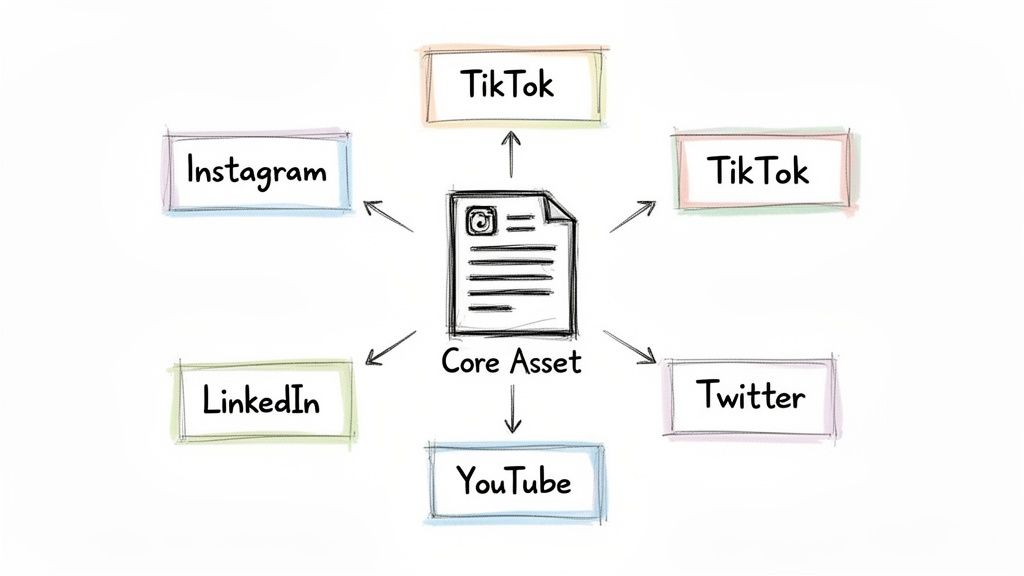
This "create once, publish everywhere" approach is one of the most scalable social media content calendar examples available. For instance, entrepreneur Alex Hormozi’s team turns his long-form interviews into dozens of short, high-impact "One Minute Clips" for platforms like TikTok, Instagram Reels, and YouTube Shorts. This system allows for a massive content output and consistent messaging across all channels without an exponential increase in creation time.
Strategic Breakdown and Use Case
This calendar is perfect for creators and brands who produce in-depth content and want to extend its reach without burning out. It ensures message consistency while respecting the unique formatting and audience expectations of each platform.
When to Use: Ideal for scaling content production, maintaining a consistent presence across multiple platforms, and maximizing ROI on a single content creation effort.
Best For: Podcasters, YouTubers, bloggers, thought leaders, and brands with an established long-form content engine.
Frequency: Typically planned weekly around a single pillar asset. The calendar maps the creation of the core piece and the staggered release of its repurposed versions over the following days or week.
Actionable Takeaways for Implementation
Effective implementation requires a systematic approach to breaking down your core content into smaller, platform-native assets.
Key Tactic: Use a project management tool to create a "Repurposing Template." For each pillar asset, list out the derivative pieces to be created: 5-7 short video clips, 2-3 quote graphics, one audiogram, one LinkedIn carousel, and one Twitter thread. Assign each to a team member with a deadline.
Here are steps to put this calendar into action:
Select Your Pillar Content: Each week, choose one high-value piece of long-form content (a new podcast episode, a webinar, a detailed blog post) to be your foundation.
Atomize the Content: Break down the pillar asset into its most valuable components: key quotes, insightful data points, actionable steps, or compelling story snippets.
Adapt for Each Platform: Customize each snippet for its target platform. A video clip becomes a 9:16 Reel for Instagram, a key statistic becomes a text-based tweet, and a series of tips becomes a LinkedIn carousel. You can learn more about extending your social media reach with this method.
Schedule with Staggered Timing: Use a scheduler's calendar view to stagger the repurposed posts. This prevents audience fatigue and allows you to drive traffic back to the core asset from different angles over several days.
8. The Collaboration & Editorial Review Calendar
The Collaboration & Editorial Review Calendar is an operational framework designed for teams, transforming content creation from a siloed task into a transparent, multi-stage workflow. Its primary function is to manage content production from ideation to publication, incorporating clear approval stages, feedback loops, and accountability. This calendar visualizes the status of each content piece (e.g., Draft, In Review, Approved, Scheduled) and assigns clear ownership at every step.
This model is one of the most crucial social media content calendar examples for growing teams and agencies because it eliminates bottlenecks and ensures quality control. Think of how large brands like Nike or agency workflows at Sprout Social manage global campaigns; they rely on structured review processes to maintain brand consistency, legal compliance, and strategic alignment. This calendar formalizes that process, preventing errors and last-minute chaos.
Strategic Breakdown and Use Case
This calendar is essential for any organization where multiple stakeholders must approve content before it goes live. It provides a single source of truth, reducing miscommunication and lost feedback that often occurs in email chains or direct messages. It’s built for consistency, quality, and accountability.
When to Use: Necessary when content requires review from legal, brand, management, or client teams. Perfect for scaling content production without sacrificing quality.
Best For: Marketing agencies, large corporate teams, regulated industries (finance, healthcare), and brands with strict voice and style guidelines.
Frequency: This is an "always-on" operational calendar, typically managed in real-time with weekly check-ins to review progress and address any blockers in the workflow.
Actionable Takeaways for Implementation
A successful collaboration calendar hinges on clearly defined stages and roles. Without them, the process can become just as chaotic as having no system at all.
Here are steps to put this calendar into action:
Define Your Workflow Stages: Map out every step your content takes from concept to publication. Clearly define what needs to happen at each stage.
Assign Roles and Responsibilities: Designate creators, reviewers, and approvers for all content. Ensure everyone understands their specific duties and deadlines. For a deeper dive, explore how to build a robust content approval workflow for faster feedback.
Establish a Style Guide: Create and share a central document outlining your brand voice, tone, visual standards, and compliance rules. Link this guide within your calendar for easy reference during the review stage.
Centralize Feedback: Use the comment and feedback features within your scheduling tool to keep all revision notes attached to the specific piece of content. This eliminates searching through emails and ensures a clear record of requested changes.
8. Social Media Content Calendars Compared
Approach | 🔄 Implementation complexity | ⚡ Resource & efficiency | 📊 Expected outcomes | 💡 Ideal use cases | ⭐ Key advantages |
|---|---|---|---|---|---|
The 80/20 Content Mix Calendar | Low–Medium — simple ratio rules and scheduling | Moderate — continuous creative output required | Improved engagement and trust; balanced promotion vs value | Content creators, influencers, brands focused on long-term loyalty | Maintains audience trust; reduces promo fatigue; easy cross-platform use |
The Pillar & Cluster Content Calendar | Medium–High — requires topic research and mapping | High upfront effort; efficient repurposing afterward | Stronger SEO, topical authority, improved discoverability | Agencies, DTC brands, thought leaders building expertise | Builds authority; efficient repurposing; boosts searchability |
The Seasonal & Event-Based Content Calendar | Medium — advance planning of dates and deadlines (3–6 months) | Variable — high production near peaks; needs lead time | Predictable engagement/sales spikes; audience anticipation | E‑commerce, retail, product launches, seasonal services | Captures peak demand; enables planned campaigns and quality assets |
The Content Batching & Batch Calendar | Low–Medium — set batch days and workflows | Very efficient — high output in short windows; reduces daily load | Consistent publishing; less creator burnout; stable quality | Solo creators, small teams, creators facing burnout | Improves consistency and quality; streamlines production |
The Data-Driven Performance Calendar | High — analytics integration, A/B testing, iterative planning | Resource-intensive — analytics tools and expertise needed | Maximized engagement/ROI; fewer assumptions; rapid optimization | Marketing managers, agencies, data-focused creators | Data-backed decisions; identifies top-performing content |
The Content Themes & Recurring Series Calendar | Low — define themes and repeat schedule | Efficient — predictable ideation and production cadence | Habit-forming audience behavior; steady engagement | Personal brands, solo creators, audience-focused channels | Reduces ideation time; builds loyalty and predictable formats |
The Multi-Platform Repurposing Calendar | Medium — create core asset + platform-specific variants | Resource-efficient — extends ROI of one core asset across channels | Broader reach; consistent messaging; saved production time | Freelancers, agencies, resource-constrained teams | Maximizes content ROI; consistent cross-platform presence |
The Collaboration & Editorial Review Calendar | High — multi-stage workflows, approvals, and ownership | Slower but controlled — requires team coordination and adoption | Higher content quality, brand safety, fewer publishing errors | Agencies, marketing teams, large brand social teams | Ensures quality and compliance; clear accountability and process |
Choosing Your Calendar: How to Build a System That Works for You
We've explored a wide array of powerful social media content calendar examples, from the strategic 80/20 mix to the hyper-efficient content batching model. The most critical takeaway is that there is no single "perfect" calendar. The ideal system is not one you find, but one you build. It’s a hybrid model, a strategic fusion of the principles that best serve your unique goals, resources, and creative rhythm.
A solo creator might thrive by combining the Pillar & Cluster Calendar with a Content Batching workflow. A busy marketing agency, on the other hand, will likely need to integrate the Collaboration & Editorial Review Calendar with a Data-Driven Performance model to manage client expectations and prove ROI. The examples in this article are not rigid prescriptions; they are building blocks.
From Inspiration to Implementation: Your Action Plan
Moving from understanding these concepts to implementing them is the most important step you can take. The goal is to create a system that eliminates the daily scramble for ideas and replaces it with intentional, strategic execution. A well-designed calendar transforms your social media efforts from a reactive chore into a proactive growth engine.
Here’s how to start building your custom system today:
Identify Your Core Model: Review the calendars we covered. Which one resonates most with your primary objective? Is it maximizing engagement (80/20 Mix), establishing authority (Pillar & Cluster), or streamlining production (Content Batching)? Choose one as your foundation.
Layer on a Secondary Strategy: Now, select a complementary model to enhance your core system. If you chose the Pillar & Cluster model, layering the Multi-Platform Repurposing Calendar on top is a natural fit. If you started with the Seasonal & Event-Based Calendar, adding a Collaboration workflow will help manage partnerships during peak campaigns.
Define Your Non-Negotiables: What are the absolute must-haves for your workflow? This could include multi-stage approval processes, performance analytics integration, or specific content theme tags. Listing these ensures that whatever tool you choose can support your essential operations.
Choose a Tool Built for Your Strategy: A generic spreadsheet or a basic scheduler will quickly become a bottleneck. You need a platform designed to handle the complexities of modern content strategy. This is where a dedicated tool becomes indispensable, allowing you to visualize, execute, and analyze your custom calendar framework without the friction of manual tracking.
The True Value of a Strategic Calendar
Mastering your content calendar is about more than just organization. It’s about reclaiming creative energy. When you are no longer burdened by the constant pressure of "what to post next," you can redirect that mental bandwidth toward what truly matters: creating high-impact content, engaging with your audience, and analyzing performance to make smarter decisions.
The social media content calendar examples we've detailed provide a roadmap. They show how successful brands and creators build systems that produce consistent, high-quality results. By adopting these principles and customizing them to your needs, you can finally move beyond inconsistent posting and build a powerful, predictable, and scalable social media presence that drives meaningful growth.
Ready to put these examples into practice and build your ultimate content system? Beplan was designed to bring every calendar strategy to life, from Kanban boards for batching to campaign timelines for seasonal events, all in one intuitive platform. Stop wrestling with spreadsheets and start executing your strategy with a tool built for creators and marketers by signing up for Beplan today.
Related articles
Our platform is designed to empower businesses of all sizes to work smarter and achieve their goals with confidence.